· H2 Mathematics — Ten-Year Series, worked ← All 10 questions

2018 A-Level · Paper 2 · Question 10

2018 H2 Maths Paper 2, Question 10

Normal distribution 15 marks sums of normal variables
Download Paper 2 solutions (PDF)

Part (i)

2 marks

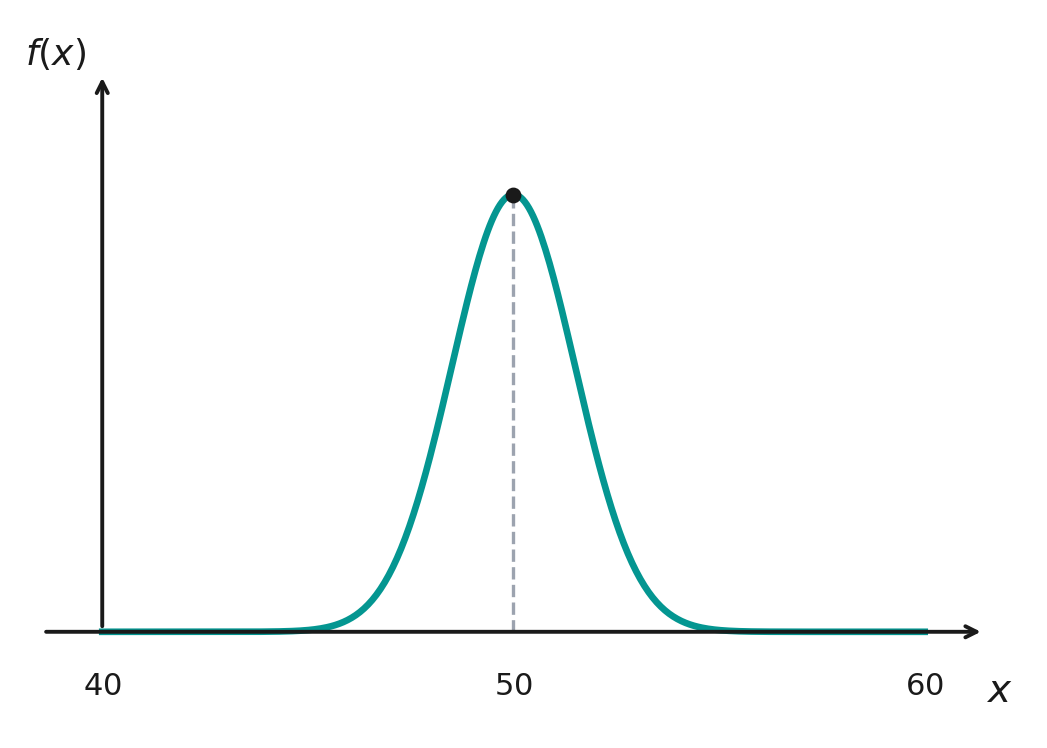
Let XX be the mass, in grams, of a randomly chosen light bulb. Then X∼N(50, 1.52)X \sim N\left( 50,\ {1.5}^{2} \right), so the density is a symmetric bell curve centred at x=50x = 50.

Sketch for question 10

Part (ii)

1 mark

Standardising, with Z=X−501.5∼N(0,1)Z = \frac{X - 50}{1.5} \sim N(0,1),

P(X<50.4)P(X < 50.4)
=P(Z<50.4−501.5)= P\left( Z < \frac{50.4 - 50}{1.5} \right)
=0.605 (3 s.f., by GC).= 0.605\ \text{(3 s.f., by GC).}

∴P(X<50.4)=0.605\therefore P(X < 50.4) = 0.605, correct to 3 s.f.

Part (iii)

2 marks

Approach

“total mass of 4 randomly chosen empty boxes” is a sum of 4 independent normal random variables, not 4 times a single box’s mass — the mean scales by 44 but the variance also scales by 44 (not 1616), since the boxes are independent.

Let YY be the mass, in grams, of a randomly chosen empty box, so Y∼N(75, 22)Y \sim N\left( 75,\ 2^{2} \right). Let T=Y1+Y2+Y3+Y4T = Y_{1} + Y_{2} + Y_{3} + Y_{4} be the total mass of 4 independently, randomly chosen empty boxes. Since the YiY_{i} are independent,

T∼N(4(75), 4(22))=N(300, 16).T \sim N\left( 4(75),\ 4\left( 2^{2} \right) \right) = N(300,\ 16).
P(T>297)=0.773 (3 s.f., by GC).P(T > 297) = 0.773\ \text{(3 s.f., by GC).}

∴P(T>297)=0.773\therefore P(T > 297) = 0.773, correct to 3 s.f.

Part (iv)

3 marks

Let W=X+YW = X + Y be the total mass, in grams, of a randomly chosen light bulb together with a randomly chosen box. Assuming the bulb’s mass and the box’s mass are independent,

W∼N(50+75, 1.52+22)=N(125, 6.25).W \sim N\left( 50 + 75,\ {1.5}^{2} + 2^{2} \right) = N(125,\ 6.25).
P(124.9<W<125.7)=0.126 (3 s.f., by GC).P(124.9 < W < 125.7) = 0.126\ \text{(3 s.f., by GC).}

∴P(124.9<W<125.7)=0.126\therefore P(124.9 < W < 125.7) = 0.126, correct to 3 s.f.

Part (v)

4 marks

Approach

the padding’s mass is 30%30\% of the bulb’s mass, i.e. 0.3X0.3X — a fixed multiple of XX, not a separate independent random variable — so the total mass of box, bulb and padding is Y+X+0.3X=Y+1.3XY + X + 0.3X = Y + 1.3X. We find the distribution of Y+1.3XY + 1.3X, then use the given tail probability to solve for kk.

Let U=Y+X+0.3X=Y+1.3XU = Y + X + 0.3X = Y + 1.3X be the total mass, in grams, of a box containing a bulb and its padding. Since XX and YY are independent,

1.3X∼N(1.3(50), 1.32(1.52))=N(65, 3.8025)1.3X \sim N\left( 1.3(50),\ {1.3}^{2}\left( {1.5}^{2} \right) \right) = N(65,\ 3.8025)
U=Y+1.3X∼N(75+65, 22+3.8025)=N(140, 7.8025).U = Y + 1.3X \sim N\left( 75 + 65,\ 2^{2} + 3.8025 \right) = N(140,\ 7.8025).

We are given P(U>k)=0.9P(U > k) = 0.9. Standardising,

P(Z>k−1407.8025)=0.9, where Z∼N(0,1).P\left( Z > \frac{k - 140}{\sqrt{7.8025}} \right) = 0.9,\ \text{where}\ Z \sim N(0,1).

By GC (inverse normal),

k−1407.8025=−1.2816…\frac{k - 140}{\sqrt{7.8025}} = - 1.2816\ldots
⇒k=140−1.2816…×7.8025\Rightarrow k = 140 - 1.2816\ldots \times \sqrt{7.8025}
=136 (3 s.f.)= 136\ \text{(3 s.f.)}
To check your answer: since P(U>k)=0.9>0.5P(U > k) = 0.9 > 0.5, kk should be below the mean 140140; k=136k = 136 is indeed below 140140. ✓

∴k=136\therefore k = 136, correct to 3 s.f.

Part (vi)

3 marks

Approach

as in (iii), “total mass of 4 boxes, each containing a bulb and padding” sums 4 independent copies of UU from (v).

Let S=U1+U2+U3+U4S = U_{1} + U_{2} + U_{3} + U_{4} be the total mass of 4 independently, randomly chosen boxes, each containing a bulb and padding. Since the UiU_{i} are independent,

S∼N(4(140), 4(7.8025))=N(560, 31.21).S \sim N\left( 4(140),\ 4(7.8025) \right) = N(560,\ 31.21).
P(S>565)=0.185 (3 s.f., by GC).P(S > 565) = 0.185\ \text{(3 s.f., by GC).}

∴P(S>565)=0.185\therefore P(S > 565) = 0.185, correct to 3 s.f.

This is how we mark, and how we teach.

Every Ten-Year Series question, worked in full, with the reasoning written out and the traps named.

Find out more