· H2 Mathematics — Ten-Year Series, worked ← All 11 questions

2023 A-Level · Paper 1 · Question 7

2023 H2 Maths Paper 1, Question 7

Functions 10 marks Inverse Functions
Download Paper 1 solutions (PDF)

Part (a)

3 marks

Approach

dropping the modulus first, we write g(x)=2x+43−xg(x) = \frac{2x + 4}{3 - x} as −2+103−x- 2 + \frac{10}{3 - x}, which exposes its asymptotes and monotonicity at once; f=∣g∣f = |g| then follows by reflecting the negative parts of gg above the xx-axis.

Writing 2x+4=−2(3−x)+102x + 4 = - 2(3 - x) + 10,

g(x)=2x+43−xg(x) = \frac{2x + 4}{3 - x}
=−2(3−x)+103−x= \frac{- 2(3 - x) + 10}{3 - x}
=−2+103−x= - 2 + \frac{10}{3 - x}

As x→±∞x \rightarrow \pm \infty, 103−x→0\frac{10}{3 - x} \rightarrow 0, so g(x)→−2g(x) \rightarrow - 2: gg has horizontal asymptote y=−2y = - 2, so f=∣g∣f = |g| has horizontal asymptote y=2y = 2. There is a vertical asymptote x=3x = 3, where the denominator vanishes.

ddx[−2+103−x]=10(3−x)2>0 for all x≠3,\frac{d}{dx}\left\lbrack - 2 + \frac{10}{3 - x} \right\rbrack = \frac{10}{(3 - x)^{2}} > 0\ \text{for all }x \neq 3,

so gg is strictly increasing on each branch. Since g(−2)=0g( - 2) = 0, g(x)<0g(x) < 0 for x<−2x < - 2 and g(x)>0g(x) > 0 for −2<x<3- 2 < x < 3; and g(x)<0g(x) < 0 throughout x>3x > 3, since g→−∞g \rightarrow - \infty as x→3+x \rightarrow 3^{\text{+}} and g→−2g \rightarrow - 2 as x→∞x \rightarrow \infty.

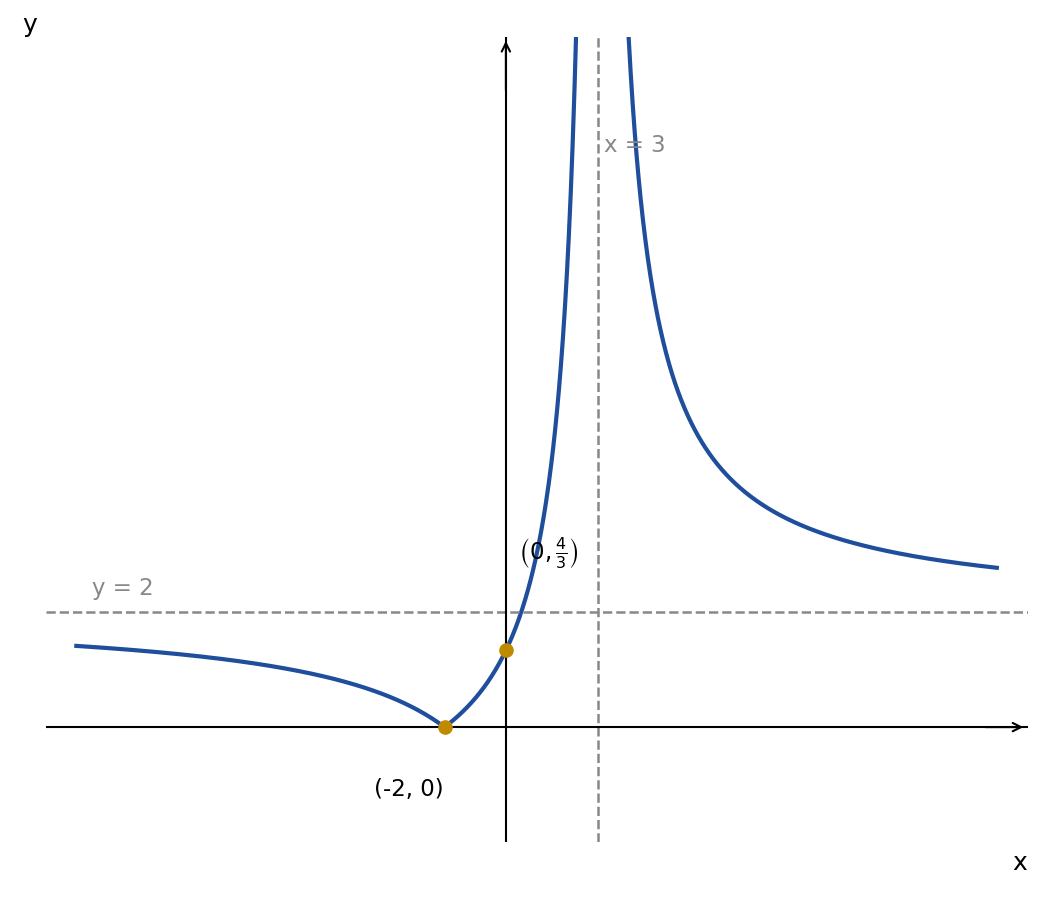
Taking f=∣g∣f = |g|: ff decreases from 22 (as x→−∞x \rightarrow - \infty) to f(−2)=0f( - 2) = 0, a cusp where gg changes sign, then increases from 00 to +∞\text{+}\infty as x→3−x \rightarrow 3^{-}; for x>3x > 3, ff decreases from +∞\text{+}\infty towards 22.

xx-intercept: g(x)=0⇒2x+4=0⇒x=−2g(x) = 0 \Rightarrow 2x + 4 = 0 \Rightarrow x = - 2, giving (−2,0)( - 2,0). yy-intercept: f(0)=∣43∣=43f(0) = \left| \frac{4}{3} \right| = \frac{4}{3}, giving (0,43)\left( 0,\frac{4}{3} \right).

To check your answer: g(−3)=−6+43+3=−13g( - 3) = \frac{- 6 + 4}{3 + 3} = - \frac{1}{3}, so f(−3)=13f( - 3) = \frac{1}{3}, consistent with ff decreasing towards 00 as x→−2−x \rightarrow - 2^{-} ✓
Sketch for question 7

∴\therefore asymptotes x=3x = 3 and y=2y = 2; axis intercepts (−2,0)( - 2,0) and (0,43)\left( 0,\frac{4}{3} \right).

Part (b)

1 mark

From the sketch, the branch −2≤x<3- 2 \leq x < 3 alone rises continuously from f(−2)=0f( - 2) = 0 to +∞\text{+}\infty, covering every value in [0,∞)\lbrack 0,\infty).

∴\therefore range of f=[0,∞)f = \lbrack 0,\infty).

Part (c)

1 mark

f2f^{2} does not exist.

Explanation: for f∘ff \circ f to exist, the range of ff must be a subset of the domain of ff. The domain of ff is all real xx except x=3x = 3, but the range [0,∞)\lbrack 0,\infty) includes 33 — e.g. f(1)=∣62∣=3f(1) = \left| \frac{6}{2} \right| = 3 — so f(f(1))=f(3)f\left( f(1) \right) = f(3) is undefined.

Part (d)

1 mark

a=−2a = - 2

Explanation: from the sketch, ff decreases on (−∞,−2]( - \infty, - 2\rbrack and increases on [−2,3)\lbrack - 2,3), with a cusp (minimum) at x=−2x = - 2. Restricting to x≤ax \leq a keeps ff one-one, so that f−1f^{- 1} exists, only while the domain avoids containing both a decreasing and an increasing portion; the greatest such aa is where the turning point occurs.

Part (e)

4 marks

With domain restricted to x≤−2x \leq - 2, g(x)≤0g(x) \leq 0 throughout, so f(x)=−g(x)=2−103−xf(x) = - g(x) = 2 - \frac{10}{3 - x}.

Let y=2−103−xy = 2 - \frac{10}{3 - x} and solve for xx in terms of yy.

y=2−103−xy = 2 - \frac{10}{3 - x}
⇒103−x=2−y\Rightarrow \frac{10}{3 - x} = 2 - y
⇒3−x=102−y\Rightarrow 3 - x = \frac{10}{2 - y}
⇒x=3−102−y=3+10y−2\Rightarrow x = 3 - \frac{10}{2 - y} = 3 + \frac{10}{y - 2}

Replacing yy by xx: f−1(x)=3+10x−2f^{- 1}(x) = 3 + \frac{10}{x - 2}.

The domain of f−1f^{- 1} equals the range of the restricted ff: on x≤−2x \leq - 2, f(−2)=0f( - 2) = 0 and f→2f \rightarrow 2 (not attained) as x→−∞x \rightarrow - \infty, so the range of the restricted ff is [0,2)\lbrack 0,2).

To check your answer: f−1(0)=3+100−2=3−5=−2f^{- 1}(0) = 3 + \frac{10}{0 - 2} = 3 - 5 = - 2, matching f(−2)=0f( - 2) = 0 ✓

∴f−1(x)=3+10x−2\therefore f^{- 1}(x) = 3 + \frac{10}{x - 2}, for 0≤x<20 \leq x < 2.

This is how we mark, and how we teach.

Every Ten-Year Series question, worked in full, with the reasoning written out and the traps named.

Find out more