· H2 Mathematics — Ten-Year Series, worked ← All 12 questions

2022 A-Level · Paper 1 · Question 10

2022 H2 Maths Paper 1, Question 10

Graphs and Transformations 10 marks Properties of graphs
Download Paper 1 solutions (PDF)

Part (a)

3 marks

Approach

“no stationary points” is a statement about when dydx=0\frac{dy}{dx} = 0 has no solution for x≠1x \neq 1, so we solve for (x−1)2(x - 1)^{2} and ask when that equation is unsolvable rather than searching for turning points directly.

The curve has equation

y=ax+b+a+2bx−1,a>0, b≠−12a, x≠1y = ax + b + \frac{a + 2b}{x - 1},\quad a > 0,\ b \neq - \frac{1}{2}a,\ x \neq 1

Differentiating,

dydx=a−a+2b(x−1)2\frac{dy}{dx} = a - \frac{a + 2b}{(x - 1)^{2}}

At a stationary point, dydx=0\frac{dy}{dx} = 0:

a−a+2b(x−1)2=0⇒(x−1)2=a+2baa - \frac{a + 2b}{(x - 1)^{2}} = 0 \Rightarrow (x - 1)^{2} = \frac{a + 2b}{a}

Since x≠1x \neq 1, (x−1)2(x - 1)^{2} takes every value in (0,∞)(0,\infty) as xx ranges over its domain, so this equation has a solution (a stationary point exists) exactly when a+2ba>0\frac{a + 2b}{a} > 0, and has none when a+2ba≤0\frac{a + 2b}{a} \leq 0. For CC to have no stationary points we therefore need a+2ba≤0\frac{a + 2b}{a} \leq 0; since a>0a > 0,

a+2b≤0a + 2b \leq 0

We are given b≠−12ab \neq - \frac{1}{2}a, i.e. a+2b≠0a + 2b \neq 0, so equality is excluded:

a+2b<0a + 2b < 0
To check your answer: with a=2a = 2, b=−2b = - 2 (so a+2b=−2<0a + 2b = - 2 < 0): dydx=2−−2(x−1)2=2+2(x−1)2>0\frac{dy}{dx} = 2 - \frac{- 2}{(x - 1)^{2}} = 2 + \frac{2}{(x - 1)^{2}} > 0 for all x≠1x \neq 1, so there is indeed no stationary point ✓

∴\therefore a+2b<0a + 2b < 0, i.e. b<−12ab < - \frac{1}{2}a.

Part (b)

4 marks

Approach

before sketching we pin down every feature algebraically — both asymptotes, both intercepts — then plot.

With b=−2ab = - 2a: a+2b=a−4a=−3aa + 2b = a - 4a = - 3a, so

y=ax+(−2a)+−3ax−1=a(x−2)−3ax−1y = ax + ( - 2a) + \frac{- 3a}{x - 1} = a(x - 2) - \frac{3a}{x - 1}

Since the curve is undefined at x=1x = 1, x=1x = 1 is a vertical asymptote. As x→±∞x \rightarrow \pm \infty, 3ax−1→0\frac{3a}{x - 1} \rightarrow 0, so

y→a(x−2)y \rightarrow a(x - 2)

is the oblique asymptote. At x=0x = 0:

y=a(0−2)−3a0−1=−2a+3a=ay = a(0 - 2) - \frac{3a}{0 - 1} = - 2a + 3a = a

so CC crosses the yy-axis at (0,a)(0,a). Setting y=0y = 0 and dividing by aa (since a>0a > 0):

(x−2)−3x−1=0(x - 2) - \frac{3}{x - 1} = 0

Multiplying through by (x−1)(x - 1):

(x−2)(x−1)−3=0(x - 2)(x - 1) - 3 = 0
x2−3x−1=0x^{2} - 3x - 1 = 0
x=3±132x = \frac{3 \pm \sqrt{13}}{2}
To check your answer: x=3+132≈3.30x = \frac{3 + \sqrt{13}}{2} \approx 3.30; substituting into (x−2)−3x−1(x - 2) - \frac{3}{x - 1} gives ≈1.30−1.30≈0\text{≈}1.30 - 1.30 \approx 0 ✓

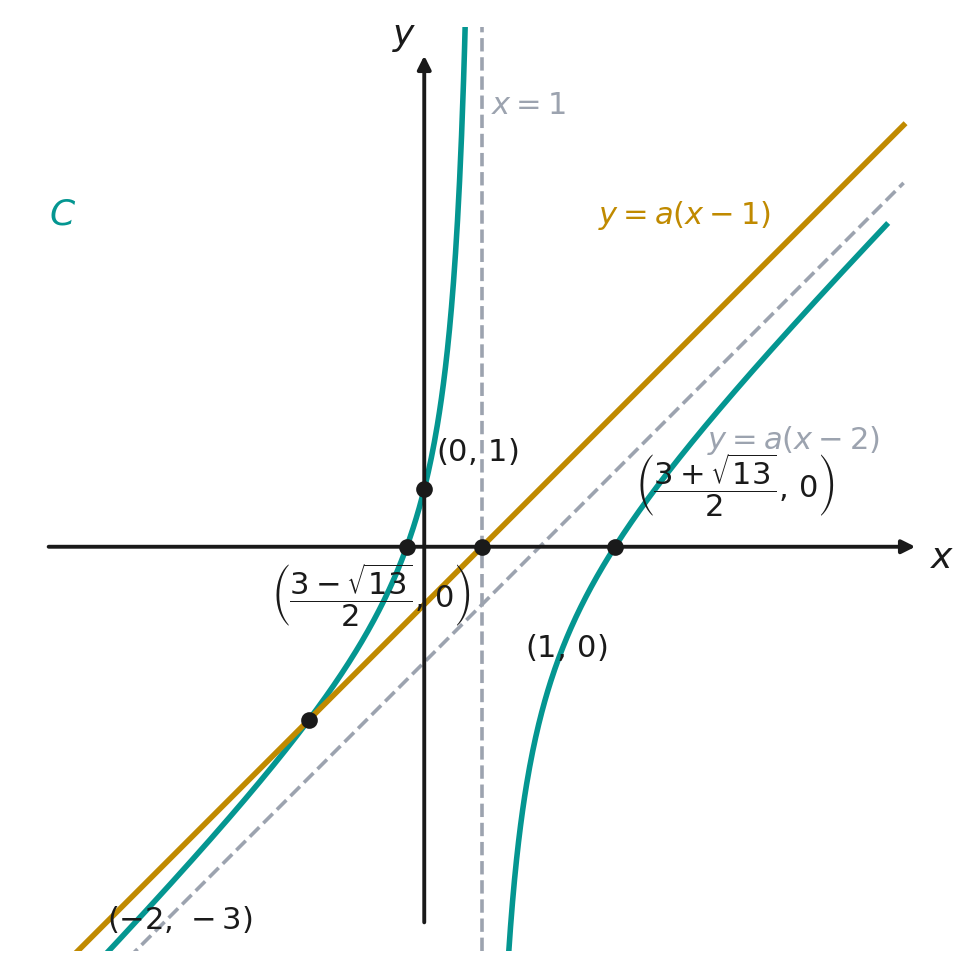
∴\therefore CC has asymptotes x=1x = 1 and y=a(x−2)y = a(x - 2), crosses the yy-axis at (0,a)(0,a), and crosses the xx-axis at x=3±132x = \frac{3 \pm \sqrt{13}}{2}.

The sketch below is drawn for a=1a = 1 (it also shows the line from part (c), in gold).

Sketch for question 10

Part (c)

1 mark

The graph of y=ax−a=a(x−1)y = ax - a = a(x - 1) is a straight line through (1,0)(1,0) with gradient aa, shown in gold on the sketch above.

Part (d)

2 marks

Approach

setting a=1a = 1 turns the given inequality into exactly “curve CC on or below the line”, which we can read from the sketch once we know where they cross.

Setting a=1a = 1 in part (b), CC becomes y=(x−2)−3x−1=x−2−3x−1y = (x - 2) - \frac{3}{x - 1} = x - 2 - \frac{3}{x - 1}, the left side of the inequality; setting a=1a = 1 in part (c), the line becomes y=x−1y = x - 1, the right side. So solving

x−2−3x−1≤x−1x - 2 - \frac{3}{x - 1} \leq x - 1

is the same as finding where CC (with a=1a = 1) lies on or below the line y=x−1y = x - 1.

To find where they meet, set a(x−2)−3ax−1=a(x−1)a(x - 2) - \frac{3a}{x - 1} = a(x - 1) and divide by aa:

(x−2)−3x−1=x−1(x - 2) - \frac{3}{x - 1} = x - 1
⇒−1−3x−1=0\Rightarrow - 1 - \frac{3}{x - 1} = 0
⇒3x−1=−1\Rightarrow \frac{3}{x - 1} = - 1
⇒x−1=−3\Rightarrow x - 1 = - 3
⇒x=−2\Rightarrow x = - 2

This is the only intersection (the equation reduced to a linear one, not quadratic), matching (−2,−3)( - 2, - 3) on the sketch.

From the sketch: for x>1x > 1, the curve descends from −∞- \infty near the asymptote and stays below the line for all x>1x > 1. For x<1x < 1, the curve descends from +∞\text{+}\infty near the asymptote, crosses the line once at x=−2x = - 2, and lies above the line for −2<x<1- 2 < x < 1 and below it for x<−2x < - 2.

∴ x≤−2 or x>1\therefore\ x \leq - 2\text{ or }x > 1
To check your answer: at x=−3x = - 3: LHS =−3−2−3−4=−4.25\text{=} - 3 - 2 - \frac{3}{- 4} = - 4.25, RHS =−4\text{=} - 4; −4.25≤−4- 4.25 \leq - 4 ✓. At x=0x = 0 (outside the solution set): LHS =1\text{=}1, RHS =−1\text{=} - 1; 1≤−11 \leq - 1 is false, correctly excluded ✓. At x=2x = 2: LHS =−3\text{=} - 3, RHS =1\text{=}1; −3≤1- 3 \leq 1 ✓

This is how we mark, and how we teach.

Every Ten-Year Series question, worked in full, with the reasoning written out and the traps named.

Find out more