· H2 Mathematics — Ten-Year Series, worked ← All 12 questions

2019 A-Level · Paper 1 · Question 10

2019 H2 Maths Paper 1, Question 10

Parametric equations 12 marks area · volume
Download Paper 1 solutions (PDF)

Part (i)

2 marks

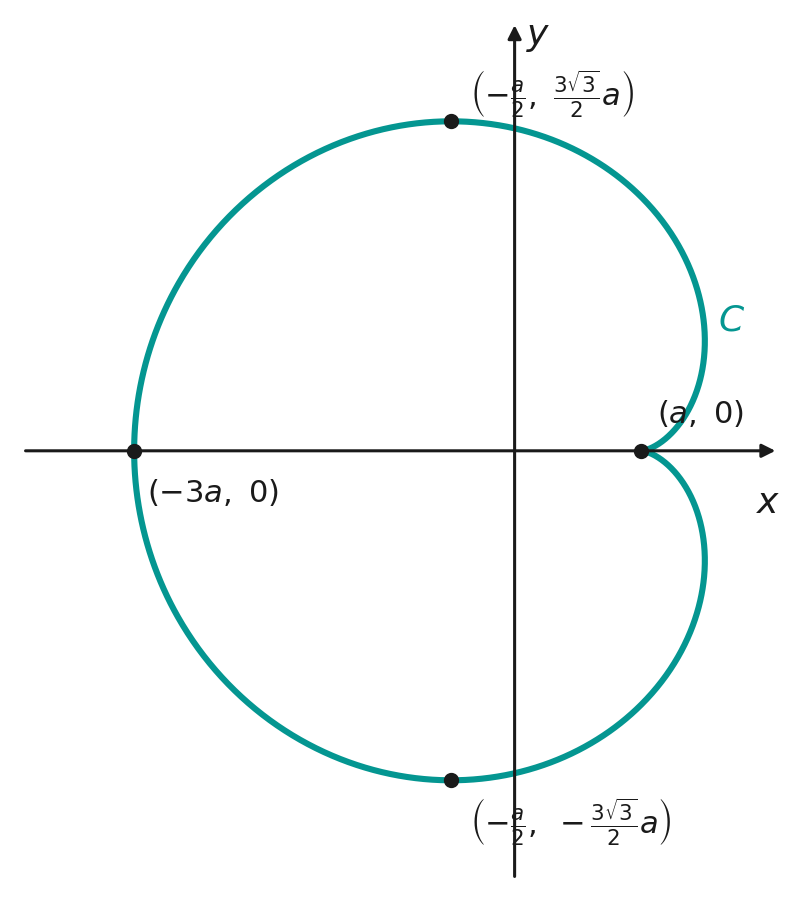
We first locate the cusp and the extreme points of CC, so the sketch is accurate.

At θ=0\theta = 0: dxdθ=2a(sin⁡2θ−sin⁡θ)=0\frac{dx}{d\theta} = 2a\left( \sin 2\theta - \sin\theta \right) = 0 and dydθ=2a(cos⁡θ−cos⁡2θ)=0\frac{dy}{d\theta} = 2a\left( \cos\theta - \cos 2\theta \right) = 0, so CC has a cusp there, at (a,0)(a,0).

At θ=π\theta = \pi: x=a(2cos⁡π−cos⁡2π)=a(−2−1)=−3ax = a\left( 2\cos\pi - \cos 2\pi \right) = a( - 2 - 1) = - 3a, y=0y = 0, giving the point (−3a,0)( - 3a,0).

Setting dydθ=0\frac{dy}{d\theta} = 0 for the turning points off the axis,

cos⁡θ=cos⁡2θ\cos\theta = \cos 2\theta
=2cos⁡2θ−1,= 2\cos^{2}\theta - 1,
2cos⁡2θ−cos⁡θ−1=02\cos^{2}\theta - \cos\theta - 1 = 0
(2cos⁡θ+1)(cos⁡θ−1)=0.\left( 2\cos\theta + 1 \right)\left( \cos\theta - 1 \right) = 0.

So cos⁡θ=1\cos\theta = 1 (the cusp, already found) or cos⁡θ=−12\cos\theta = - \frac{1}{2}, giving θ=2π3\theta = \frac{2\pi}{3} or θ=4π3\theta = \frac{4\pi}{3}. At θ=2π3\theta = \frac{2\pi}{3},

x=a(2(−12)−(−12))=−12a,y=a(2⋅32−(−32))=332a,x = a\left( 2\left( - \frac{1}{2} \right) - \left( - \frac{1}{2} \right) \right) = - \frac{1}{2}a,\quad\quad y = a\left( 2 \cdot \frac{\sqrt{3}}{2} - \left( - \frac{\sqrt{3}}{2} \right) \right) = \frac{3\sqrt{3}}{2}a,

giving the topmost point (−a2, 332a)\left( - \frac{a}{2},\ \frac{3\sqrt{3}}{2}a \right), with the mirror point (−a2, −332a)\left( - \frac{a}{2},\ - \frac{3\sqrt{3}}{2}a \right) at θ=4π3\theta = \frac{4\pi}{3} below the xx-axis.

Sketch for question 10

CC is a cardioid, symmetric about the xx-axis (shown algebraically in (ii)). Its line of symmetry has Cartesian equation

y=0.y = 0.

Part (ii)

2 marks

Approach

CC meets the xx-axis where y=0y = 0; factorising the resulting equation in θ\theta gives all the parameter values at once.

CC meets the xx-axis where y=0y = 0:

a(2sin⁡θ−sin⁡2θ)=0a\left( 2\sin\theta - \sin 2\theta \right) = 0
2sin⁡θ−2sin⁡θcos⁡θ=02\sin\theta - 2\sin\theta\cos\theta = 0
2sin⁡θ(1−cos⁡θ)=0.2\sin\theta\left( 1 - \cos\theta \right) = 0.

So sin⁡θ=0\sin\theta = 0 or cos⁡θ=1\cos\theta = 1. For 0≤θ≤2π0 \leq \theta \leq 2\pi, sin⁡θ=0\sin\theta = 0 gives θ=0, π, 2π\theta = 0,\ \pi,\ 2\pi, and cos⁡θ=1\cos\theta = 1 gives θ=0, 2π\theta = 0,\ 2\pi (already included).

∴\therefore CC meets the xx-axis at θ=0, π, 2π\theta = 0,\ \pi,\ 2\pi.

Note: θ=0\theta = 0 and θ=2π\theta = 2\pi both give the same point (a,0)(a,0), the cusp where the curve closes up; θ=π\theta = \pi gives the distinct point (−3a,0)( - 3a,0).

Part (iii)

3 marks

Approach

For 0≤θ≤π0 \leq \theta \leq \pi, y≥0y \geq 0 traces the upper half of CC from the cusp (a,0)(a,0) back to (−3a,0)( - 3a,0), with xx decreasing throughout (since the curve is traversed leftwards along the top). The area under this arc is −∫y dxdθ dθ- \int y\,\frac{dx}{d\theta}\, d\theta, the minus sign compensating for xx decreasing as θ\theta increases.

By symmetry about the xx-axis, the upper half of CC (where y≥0y \geq 0) is traced for 0≤θ≤π0 \leq \theta \leq \pi, from θ1=0\theta_{1} = 0 to θ2=π\theta_{2} = \pi. Differentiating,

dxdθ=a(−2sin⁡θ+2sin⁡2θ)=2a(sin⁡2θ−sin⁡θ).\frac{dx}{d\theta} = a\left( - 2\sin\theta + 2\sin 2\theta \right) = 2a\left( \sin 2\theta - \sin\theta \right).

Since xx decreases as θ\theta runs from 00 to π\pi, the area enclosed by the xx-axis and this arc is

Area=−∫0πy dxdθ dθ.\text{Area} = - \int_{0}^{\pi}y\,\frac{dx}{d\theta}\, d\theta.

Now

y dxdθ=a(2sin⁡θ−sin⁡2θ)⋅2a(sin⁡2θ−sin⁡θ)y\,\frac{dx}{d\theta} = a\left( 2\sin\theta - \sin 2\theta \right) \cdot 2a\left( \sin 2\theta - \sin\theta \right)
=2a2(2sin⁡θ−sin⁡2θ)(sin⁡2θ−sin⁡θ)= 2a^{2}\left( 2\sin\theta - \sin 2\theta \right)\left( \sin 2\theta - \sin\theta \right)
=2a2(3sin⁡θsin⁡2θ−2sin⁡2θ−sin⁡22θ)= 2a^{2}\left( 3\sin\theta\sin 2\theta - 2\sin^{2}\theta - \sin^{2}2\theta \right)
=a2(6sin⁡θsin⁡2θ−4sin⁡2θ−2sin⁡22θ).= a^{2}\left( 6\sin\theta\sin 2\theta - 4\sin^{2}\theta - 2\sin^{2}2\theta \right).

So

Area=−∫0πa2(6sin⁡θsin⁡2θ−4sin⁡2θ−2sin⁡22θ) dθ\text{Area} = - \int_{0}^{\pi}a^{2}\left( 6\sin\theta\sin 2\theta - 4\sin^{2}\theta - 2\sin^{2}2\theta \right)\, d\theta
=∫θ1θ2a2(4sin⁡2θ−6sin⁡θsin⁡2θ+2sin⁡22θ) dθ,= \int_{\theta_{1}}^{\theta_{2}}a^{2}\left( 4\sin^{2}\theta - 6\sin\theta\sin 2\theta + 2\sin^{2}2\theta \right)\, d\theta,

with θ1=0\theta_{1} = 0 and θ2=π\theta_{2} = \pi.   \ \ (shown)

Part (iv)

5 marks

Approach

Each term of the integrand reduces with a standard identity: sin⁡2θ\sin^{2}\theta and sin⁡22θ\sin^{2}2\theta via the double-angle cosine formula, and sin⁡θsin⁡2θ\sin\theta\sin 2\theta via the product-to-sum formula. The total area is then twice the area of the upper half, by the symmetry found in (i).

Using sin⁡2θ=12(1−cos⁡2θ)\sin^{2}\theta = \frac{1}{2}\left( 1 - \cos 2\theta \right) and sin⁡22θ=12(1−cos⁡4θ)\sin^{2}2\theta = \frac{1}{2}\left( 1 - \cos 4\theta \right),

∫0π4sin⁡2θ dθ=∫0π2(1−cos⁡2θ) dθ=2π,\int_{0}^{\pi}4\sin^{2}\theta\, d\theta = \int_{0}^{\pi}2\left( 1 - \cos 2\theta \right)\, d\theta = 2\pi,
∫0π2sin⁡22θ dθ=∫0π(1−cos⁡4θ) dθ=π.\int_{0}^{\pi}2\sin^{2}2\theta\, d\theta = \int_{0}^{\pi}\left( 1 - \cos 4\theta \right)\, d\theta = \pi.

Using sin⁡θsin⁡2θ=12(cos⁡θ−cos⁡3θ)\sin\theta\sin 2\theta = \frac{1}{2}\left( \cos\theta - \cos 3\theta \right),

∫0π6sin⁡θsin⁡2θ dθ=∫0π3(cos⁡θ−cos⁡3θ) dθ\int_{0}^{\pi}6\sin\theta\sin 2\theta\, d\theta = \int_{0}^{\pi}3\left( \cos\theta - \cos 3\theta \right)\, d\theta
=3[sin⁡θ−13sin⁡3θ]0π= 3\left\lbrack \sin\theta - \frac{1}{3}\sin 3\theta \right\rbrack_{0}^{\pi}
=0.= 0.

So the area of the upper half is

∫0πa2(4sin⁡2θ−6sin⁡θsin⁡2θ+2sin⁡22θ) dθ=a2(2π−0+π)=3πa2.\int_{0}^{\pi}a^{2}\left( 4\sin^{2}\theta - 6\sin\theta\sin 2\theta + 2\sin^{2}2\theta \right)\, d\theta = a^{2}(2\pi - 0 + \pi) = 3\pi a^{2}.

By the symmetry of CC about the xx-axis, the lower half encloses the same area, so the total area enclosed by CC is

2×3πa2=6πa2.2 \times 3\pi a^{2} = 6\pi a^{2}.
To check your answer: a numerical shoelace computation on 1000+1000\text{+} plotted points of CC with a=1a = 1 gives area ≈18.8496\text{≈}18.8496, matching 6π≈18.84966\pi \approx 18.8496. ✓

∴\therefore the total area enclosed by CC is 6πa26\pi a^{2}.

This is how we mark, and how we teach.

Every Ten-Year Series question, worked in full, with the reasoning written out and the traps named.

Find out more