· H2 Mathematics — Ten-Year Series, worked ← All 10 questions

2018 A-Level · Paper 2 · Question 2

2018 H2 Maths Paper 2, Question 2

Complex numbers 12 marks roots of polynomials · loci
Download Paper 2 solutions (PDF)

Part (a)

5 marks

Since ss and tt are real, the coefficients of the quartic are real, so complex roots occur in conjugate pairs. As 2−3i2 - 3i is a root, 2+3i2 + 3i is also a root.

(x−(2−3i))(x−(2+3i))\left( x - (2 - 3i) \right)\left( x - (2 + 3i) \right)
=((x−2)+3i)((x−2)−3i)= \left( (x - 2) + 3i \right)\left( (x - 2) - 3i \right)
=(x−2)2+9= (x - 2)^{2} + 9
=x2−4x+13= x^{2} - 4x + 13

Approach

The quartic has leading coefficient 44, and x2−4x+13x^{2} - 4x + 13 (the factor from the known conjugate pair) is monic, so the remaining quadratic factor must also be monic. We write the quartic as 4(x2−4x+13)(x2+bx+c)4\left( x^{2} - 4x + 13 \right)\left( x^{2} + bx + c \right) and compare coefficients to find bb and cc, then ss and tt.

4x4−20x3+sx2−56x+t=4(x2−4x+13)(x2+bx+c)4x^{4} - 20x^{3} + sx^{2} - 56x + t = 4\left( x^{2} - 4x + 13 \right)\left( x^{2} + bx + c \right)

Expanding the right side,

4(x2−4x+13)(x2+bx+c)4\left( x^{2} - 4x + 13 \right)\left( x^{2} + bx + c \right)
=4x4+4bx3+4cx2−16x3−16bx2−16cx+52x2+52bx+52c= 4x^{4} + 4bx^{3} + 4cx^{2} - 16x^{3} - 16bx^{2} - 16cx + 52x^{2} + 52bx + 52c
=4x4+(4b−16)x3+(4c−16b+52)x2+(52b−16c)x+52c= 4x^{4} + (4b - 16)x^{3} + (4c - 16b + 52)x^{2} + (52b - 16c)x + 52c

Comparing the coefficient of x3x^{3} with −20- 20,

4b−16=−204b - 16 = - 20
⇒b=−1\Rightarrow b = - 1

Comparing the coefficient of xx with −56- 56,

52b−16c=−5652b - 16c = - 56
⇒52(−1)−16c=−56\Rightarrow 52( - 1) - 16c = - 56
⇒c=14\Rightarrow c = \frac{1}{4}

So the other quadratic factor is x2−x+14=(x−12)2x^{2} - x + \frac{1}{4} = \left( x - \frac{1}{2} \right)^{2}, giving a repeated root x=12x = \frac{1}{2}.

Comparing the remaining coefficients,

s=4c−16b+52=4(14)−16(−1)+52=69s = 4c - 16b + 52 = 4\left( \frac{1}{4} \right) - 16( - 1) + 52 = 69
t=52c=52(14)=13t = 52c = 52\left( \frac{1}{4} \right) = 13
To check your answer: with s=69s = 69, t=13t = 13, substituting x=12x = \frac{1}{2} into 4x4−20x3+69x2−56x+134x^{4} - 20x^{3} + 69x^{2} - 56x + 13 gives 14−52+694−28+13=0\frac{1}{4} - \frac{5}{2} + \frac{69}{4} - 28 + 13 = 0. ✓

∴\therefore the other roots are x=2+3ix = 2 + 3i and x=12x = \frac{1}{2} (repeated), with s=69s = 69 and t=13t = 13.

Part (b)(i)

3 marks

Approach

A non-calculator method means we factorise w3−27w^{3} - 27 using the known root w=3w = 3, rather than solving w3=27w^{3} = 27 directly.

Since w=3w = 3 is a root of w3−27=0w^{3} - 27 = 0, (w−3)(w - 3) is a factor.

w3−27=(w−3)(w2+3w+9)w^{3} - 27 = (w - 3)\left( w^{2} + 3w + 9 \right)

The other values of ww satisfy w2+3w+9=0w^{2} + 3w + 9 = 0. By the quadratic formula,

w=−3±9−362w = \frac{- 3 \pm \sqrt{9 - 36}}{2}
=−3±−272= \frac{- 3 \pm \sqrt{- 27}}{2}
=−3±3i32= \frac{- 3 \pm 3i\sqrt{3}}{2}

∴\therefore the other values are w=−32+332iw = - \frac{3}{2} + \frac{3\sqrt{3}}{2}i and w=−32−332iw = - \frac{3}{2} - \frac{3\sqrt{3}}{2}i.

Part (b)(ii)

2 marks

For each value of ww, ∣w∣=(32)2+(332)2=94+274=3|w| = \sqrt{\left( \frac{3}{2} \right)^{2} + \left( \frac{3\sqrt{3}}{2} \right)^{2}} = \sqrt{\frac{9}{4} + \frac{27}{4}} = 3, consistent with all cube roots of 2727 having modulus 271/3=327^{1/3} = 3.

Since tan⁡(arg⁡w)=33/2−3/2=−3\tan\left( \arg w \right) = \frac{3\sqrt{3}/2}{- 3/2} = - \sqrt{3} and the point lies in the second quadrant (for the +\text{+} case) or third quadrant (for the -\text{-} case), the arguments are 2π3\frac{2\pi}{3} and −2π3- \frac{2\pi}{3}.

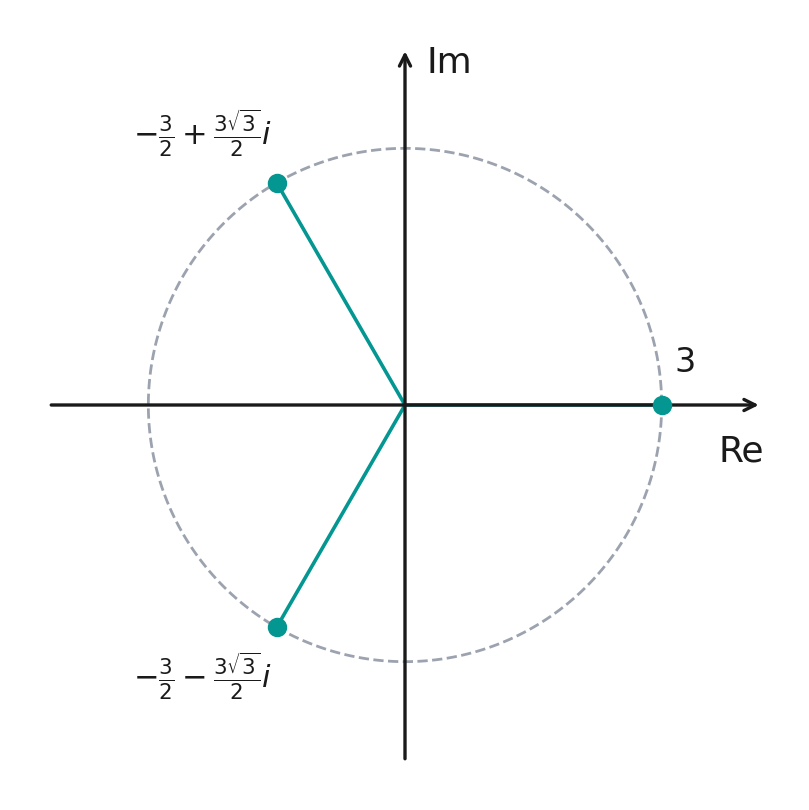
w=3,  w=3(cos⁡2π3+isin⁡2π3),  w=3(cos⁡2π3−isin⁡2π3)w = 3,\ \ w = 3\left( \cos\frac{2\pi}{3} + i\sin\frac{2\pi}{3} \right),\ \ w = 3\left( \cos\frac{2\pi}{3} - i\sin\frac{2\pi}{3} \right)
Sketch for question 2

Note: the three points lie on a circle of radius 33 centred at the origin, spaced 2π3\frac{2\pi}{3} apart, since they are the three cube roots of 2727.

Part (b)(iii)

2 marks

Approach

Rather than adding and multiplying the surd forms directly, we use the fact that the three values of ww are the roots of w3−27=0w^{3} - 27 = 0, so their sum and product follow from the coefficients.

Since w3+0w2+0w−27=0w^{3} + 0w^{2} + 0w - 27 = 0 has roots 33, −32+332i- \frac{3}{2} + \frac{3\sqrt{3}}{2}i, −32−332i- \frac{3}{2} - \frac{3\sqrt{3}}{2}i,

Sum of roots=−01=0\text{Sum of roots} = - \frac{0}{1} = 0
Product of roots=−−271=27\text{Product of roots} = - \frac{- 27}{1} = 27
To check your answer: 3(−32+332i)(−32−332i)=3(94+274)=3(9)=273\left( - \frac{3}{2} + \frac{3\sqrt{3}}{2}i \right)\left( - \frac{3}{2} - \frac{3\sqrt{3}}{2}i \right) = 3\left( \frac{9}{4} + \frac{27}{4} \right) = 3(9) = 27. ✓

∴\therefore the sum of all possible values of ww is 00 and the product is 2727.

This is how we mark, and how we teach.

Every Ten-Year Series question, worked in full, with the reasoning written out and the traps named.

Find out more