· H2 Mathematics — Ten-Year Series, worked ← All 11 questions

2017 A-Level · Paper 1 · Question 2

2017 H2 Maths Paper 1, Question 2

Inequalities 6 marks graphical solution · modulus
Download Paper 1 solutions (PDF)

Part (i)

2 marks

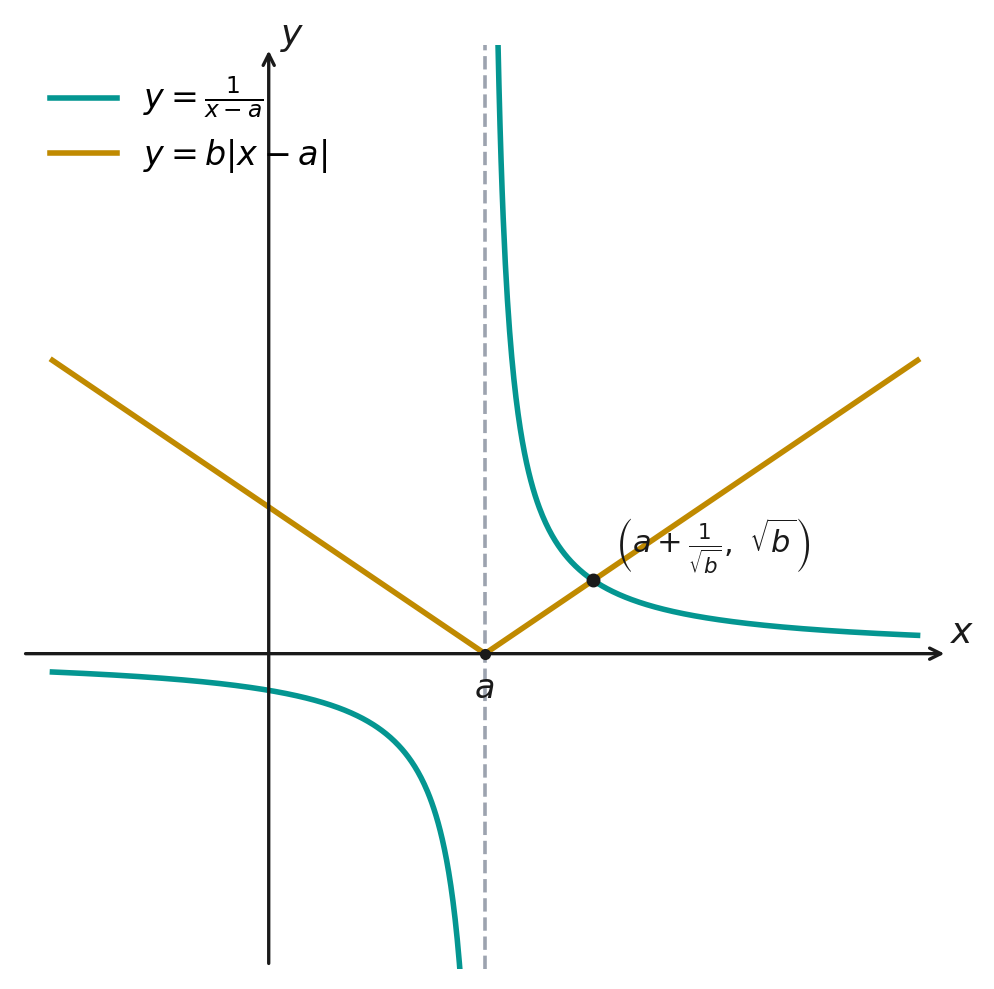
The graph of y=1x−ay = \frac{1}{x - a} is a rectangular hyperbola with vertical asymptote x=ax = a and horizontal asymptote y=0y = 0: it lies above the xx-axis for x>ax > a (decreasing towards y=0y = 0 as x→∞x \rightarrow \infty, and y→∞y \rightarrow \infty as x→a+x \rightarrow a^{\text{+}}), and below the xx-axis for x<ax < a (increasing towards y=0y = 0 as x→−∞x \rightarrow - \infty, and y→−∞y \rightarrow - \infty as x→a−x \rightarrow a^{-}).

The graph of y=b∣x−a∣y = b|x - a| is a V-shape with vertex (a, 0)(a,\ 0), gradient −b- b for x<ax < a and gradient bb for x>ax > a.

Sketch for question 2

Part (ii)

4 marks

Approach

For x<ax < a, 1x−a\frac{1}{x - a} is negative while b∣x−a∣b|x - a| is non-negative, so the inequality holds for every x<ax < a with no further work. For x>ax > a, both expressions are positive; the sketch in (i) shows 1x−a\frac{1}{x - a} starting above b∣x−a∣b|x - a| near the asymptote and ending below it as x→∞x \rightarrow \infty, so the two graphs cross exactly once, and the inequality holds beyond that crossing. We find the crossing point algebraically.

For x>ax > a, ∣x−a∣=x−a|x - a| = x - a, so we solve the equation

1x−a=b(x−a)\frac{1}{x - a} = b(x - a)
⇒1=b(x−a)2\Rightarrow 1 = b(x - a)^{2}
⇒(x−a)2=1b\Rightarrow (x - a)^{2} = \frac{1}{b}
⇒x−a=1b (since x>a, so x−a>0)\Rightarrow x - a = \frac{1}{\sqrt{b}}\ \left( \text{since x} > a,\ \text{so x} - a > 0 \right)
⇒x=a+1b\Rightarrow x = a + \frac{1}{\sqrt{b}}

Near the asymptote (x→a+x \rightarrow a^{\text{+}}), 1x−a→∞\frac{1}{x - a} \rightarrow \infty while b(x−a)→0b(x - a) \rightarrow 0, so the curve lies above the line there and the inequality fails; beyond the crossing point the line lies above the curve, so the inequality holds for x>a+1bx > a + \frac{1}{\sqrt{b}}.

Combining both regions:

x<a  or  x>a+1bx < a\ \ \text{or}\ \ x > a + \frac{1}{\sqrt{b}}
To check your answer: at x=a−1x = a - 1 (in the region x<ax < a), 1x−a=−1\frac{1}{x - a} = - 1 while b∣x−a∣=b>0b|x - a| = b > 0, so the inequality holds. ✓ At x=a+2bx = a + \frac{2}{\sqrt{b}} (beyond the crossing), 1x−a=b2\frac{1}{x - a} = \frac{\sqrt{b}}{2} while b∣x−a∣=2bb|x - a| = 2\sqrt{b}, and b2<2b\frac{\sqrt{b}}{2} < 2\sqrt{b} since b>0b > 0. ✓

∴\therefore the solution is x<ax < a or x>a+1bx > a + \frac{1}{\sqrt{b}}.

This is how we mark, and how we teach.

Every Ten-Year Series question, worked in full, with the reasoning written out and the traps named.

Find out more