· H2 Mathematics — Ten-Year Series, worked ← All 11 questions

2015 A-Level · Paper 1 · Question 2

2015 H2 Maths Paper 1, Question 2

Graphs 6 marks modulus · asymptotes
Download Paper 1 solutions (PDF)

Part (i)

3 marks

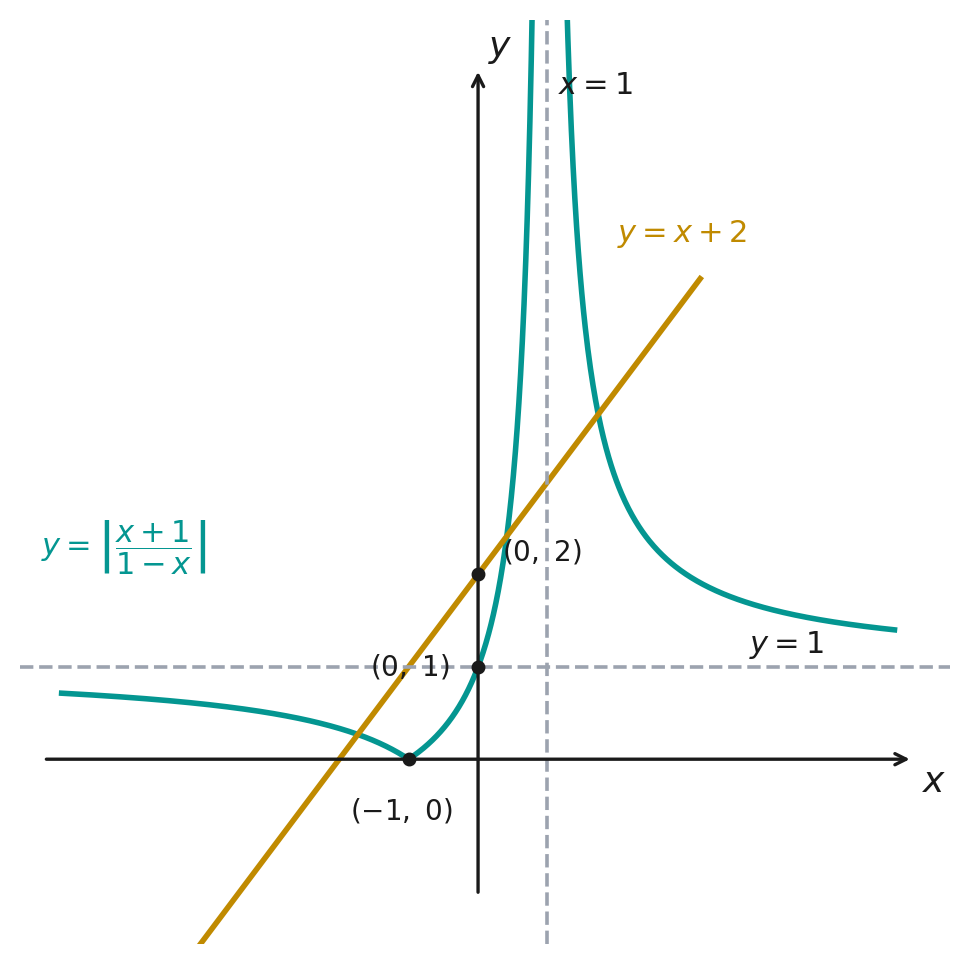
Approach: Write f(x)=x+11−xf(x) = \frac{x + 1}{1 - x} so that the required curve is y=∣f(x)∣y = \left| f(x) \right|. It is easiest to sketch y=f(x)y = f(x) first and then reflect the part below the xx-axis.

Since ff is undefined at x=1x = 1, there is a vertical asymptote x=1x = 1.

f(x)=x+11−xf(x) = \frac{x + 1}{1 - x}
=−(x−1)+2−(x−1)= \frac{- (x - 1) + 2}{- (x - 1)}
=−1−2x−1.= - 1 - \frac{2}{x - 1}.

As x→±∞x \rightarrow \pm \infty, 2x−1→0\frac{2}{x - 1} \rightarrow 0, so f(x)→−1f(x) \rightarrow - 1: the horizontal asymptote of ff is y=−1y = - 1, so for y=∣f(x)∣y = \left| f(x) \right| the horizontal asymptote is y=1y = 1.

f(x)=0f(x) = 0 at x=−1x = - 1, so y=∣f(x)∣y = \left| f(x) \right| meets the xx-axis at (−1, 0)( - 1,\ 0), and y=∣f(0)∣=1y = \left| f(0) \right| = 1 gives the yy-intercept (0, 1)(0,\ 1).

Note: ∣f(x)∣\left| f(x) \right| has a sharp corner (not a smooth turning point) at (−1, 0)( - 1,\ 0), since this is where the expression inside the modulus changes sign.

Sketch for question 2

Part (ii)

3 marks

Approach: ∣x+11−x∣<x+2\left| \frac{x + 1}{1 - x} \right| < x + 2 is exactly the inequality ∣f(x)∣<\left| f(x) \right|\text{<} (line), so its solution is read off the sketch in (i) as the set of xx for which the curve lies strictly below the line — provided we also solve algebraically for the exact intersection points, since a sketch alone does not give exact values.

Since the left side is non-negative, we need x+2>0x + 2 > 0, i.e. x>−2x > - 2, for the inequality to have any chance of holding.

We find where the curve meets the line, splitting by the sign of f(x)f(x).

For −1≤x<1- 1 \leq x < 1, f(x)≥0f(x) \geq 0, so ∣f(x)∣=f(x)\left| f(x) \right| = f(x):

x+11−x=x+2\frac{x + 1}{1 - x} = x + 2
⇒x+1=(x+2)(1−x)\Rightarrow x + 1 = (x + 2)(1 - x)
⇒x+1=−x2−x+2\Rightarrow x + 1 = - x^{2} - x + 2
⇒x2+2x−1=0\Rightarrow x^{2} + 2x - 1 = 0
⇒x=−1±2.\Rightarrow x = - 1 \pm \sqrt{2}.

Only x=2−1≈0.414x = \sqrt{2} - 1 \approx 0.414 lies in −1≤x<1- 1 \leq x < 1; x=−1−2x = - 1 - \sqrt{2} is rejected as outside this range.

For x<−1x < - 1 or x>1x > 1, f(x)<0f(x) < 0, so ∣f(x)∣=−f(x)\left| f(x) \right| = - f(x):

−x+11−x=x+2- \frac{x + 1}{1 - x} = x + 2
⇒−(x+1)=(x+2)(1−x)\Rightarrow - (x + 1) = (x + 2)(1 - x)
⇒−x−1=−x2−x+2\Rightarrow - x - 1 = - x^{2} - x + 2
⇒x2=3\Rightarrow x^{2} = 3
⇒x=±3.\Rightarrow x = \pm \sqrt{3}.

Both x=−3≈−1.732x = - \sqrt{3} \approx - 1.732 and x=3≈1.732x = \sqrt{3} \approx 1.732 lie in the valid range (x<−1x < - 1 or x>1x > 1 respectively), so both are kept.

From the sketch, the curve y=∣f(x)∣y = \left| f(x) \right| lies below the line y=x+2y = x + 2 on (−3, 2−1)\left( - \sqrt{3},\ \sqrt{2} - 1 \right) (passing continuously through the corner at x=−1x = - 1, where both graphs are defined), and again for x>3x > \sqrt{3}, where the line has overtaken the curve beyond the vertical asymptote.

To check your answer: at x=0x = 0, ∣0+11−0∣=1<2\left| \frac{0 + 1}{1 - 0} \right| = 1 < 2 ✓, and 00 lies in (−3, 2−1)\left( - \sqrt{3},\ \sqrt{2} - 1 \right). ✓

∴−3<x<2−1\therefore - \sqrt{3} < x < \sqrt{2} - 1 or x>3x > \sqrt{3}.

This is how we mark, and how we teach.

Every Ten-Year Series question, worked in full, with the reasoning written out and the traps named.

Find out more