 The Learning Cave
Part (a)
2 marks, so
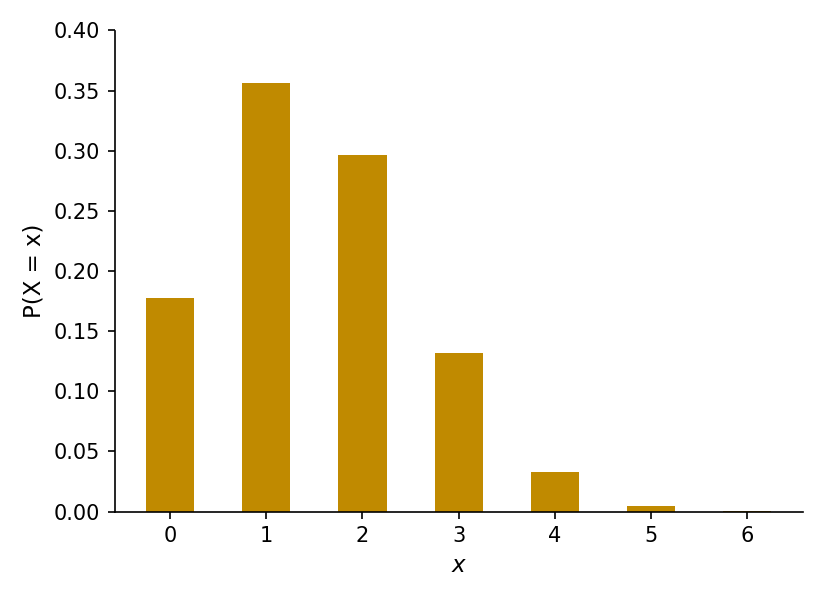
By GC, the probabilities are:
| 0 | 1 | 2 | 3 | 4 | 5 | 6 | |
|---|---|---|---|---|---|---|---|
| 0.178 | 0.356 | 0.297 | 0.132 | 0.0330 | 0.00439 | 0.000244 |
Part (b)
2 marksOver the 80 days, the total number of pies tested is .
Estimating the probability by the observed proportion,
.
Part (c)(i)
2 marksEach burger has the same, constant probability of having insufficient cheese, regardless of which burger it is or which day it is tested (the probability does not vary from burger to burger or day to day).
Whether any one burger has insufficient cheese is independent of whether any other burger does (burgers are filled/tested independently of one another).
Part (c)(ii)
1 mark. Converting the tail to cumulative form for the GC,
| To check your answer: adding the three terms directly, . ✓ |
.
Part (c)(iii)
2 marksApproach
“Fewer than 3 burgers with insufficient cheese” happening on a given day is itself a Bernoulli event, with probability found in (ii); we count how many of the 28 (independent) days this happens on, which is binomial.
Let be the number of days, out of 28, on which fewer than 3 burgers have insufficient cheese. Since the days are independent, each with the probability found in (ii),
days.
Part (c)(iv)
2 marksApproach
Over 28 days the total number of burgers tested is fixed (), each independently having insufficient cheese with probability , so the total count is itself binomial, and the GC gives its cumulative probabilities directly.
Let be the total number of burgers, out of tested over the 28 days, found to have insufficient cheese. Since the days are independent with the same ,
Converting the tail to cumulative form for the GC,
| To check your answer: , so asking for more than 100 is asking for roughly “more than the mean”, and an answer close to is what we expect. ✓ |
.