 The Learning Cave
Part (a)(i)
1 markSince meets the axes at and , and is the reflection of in the line , each labelled point swaps its coordinates: maps to , and maps to .
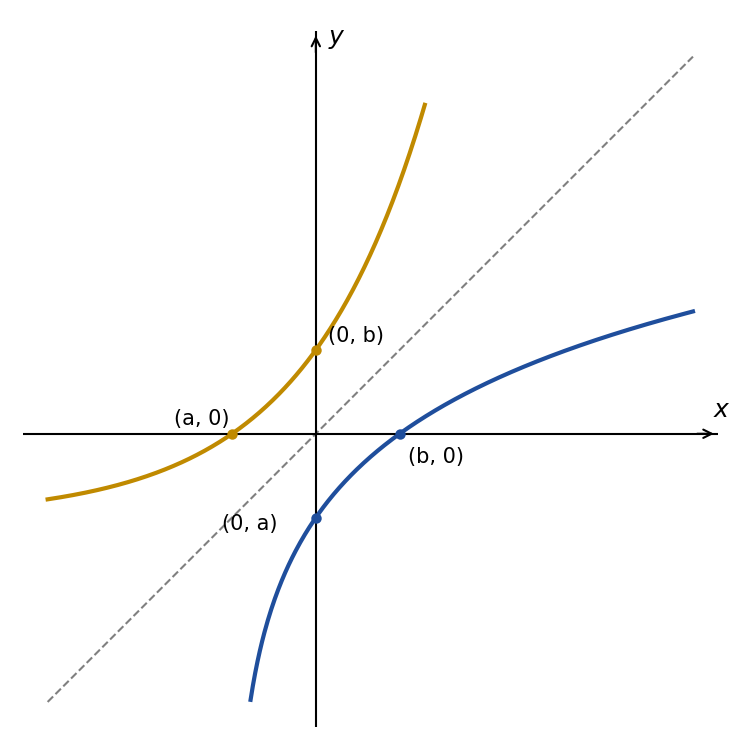
is the reflection of in , cutting the axes at and .
Part (a)(ii)
2 marksApproach
is built from by two transformations: replace with (translation in the -direction), then double the resulting -values (stretch, scale factor , parallel to the -axis). Only the -intercept is required, and a -stretch does not move a point already on the -axis, so we only need to track how the translation moves the -intercept of .
From part (i), has -intercept . Setting in the transformed curve,
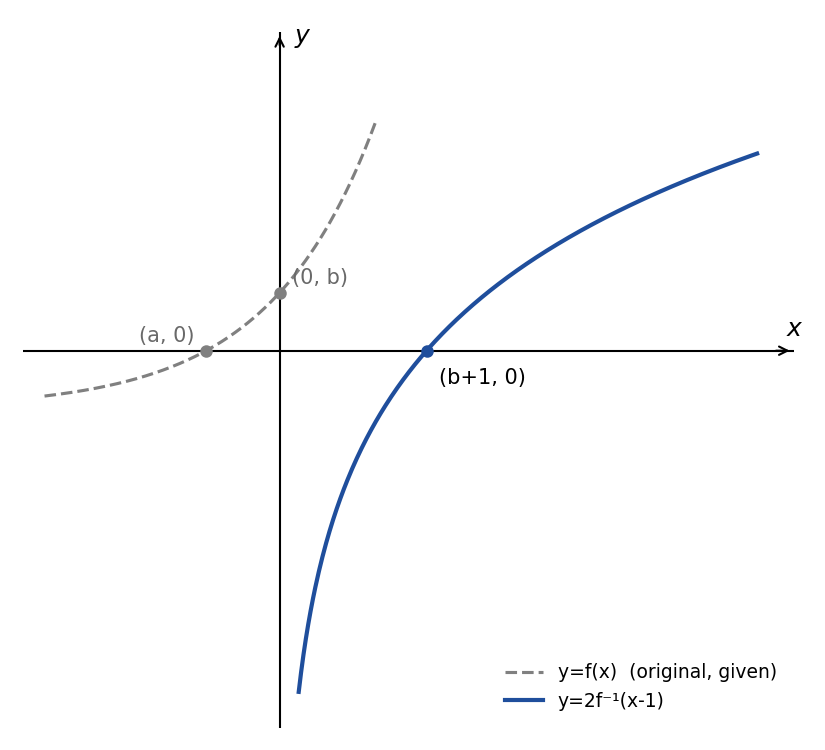
has -intercept .
Part (b)(i)
2 marksagrees with wherever , and reflects upward (in the -axis) the part where . The dip between and , where , is reflected up so the curve touches the -axis at and instead of crossing it; the arch from to , already non-negative, is unchanged; beyond , where falls below the axis, that branch is reflected to rise instead.
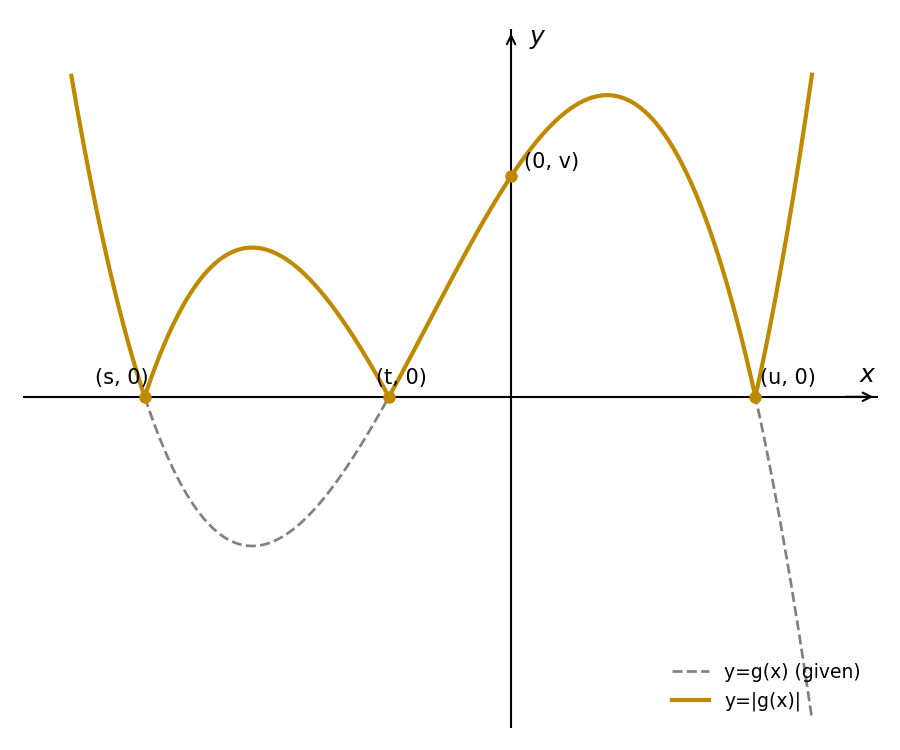
touches the -axis at and , meets it at , and cuts the -axis at .
Part (b)(ii)
2 marksApproach
is an even function, so the sketch has two parts: for it is identical to , and for it is the mirror image, in the -axis, of that same branch — the original branch of for is discarded entirely.
The right-hand branch of passes through , rises to a local maximum, then falls through . Reflecting this branch in the -axis gives a symmetric curve with a local minimum at , rising to two symmetric maxima, and crossing the -axis at and .
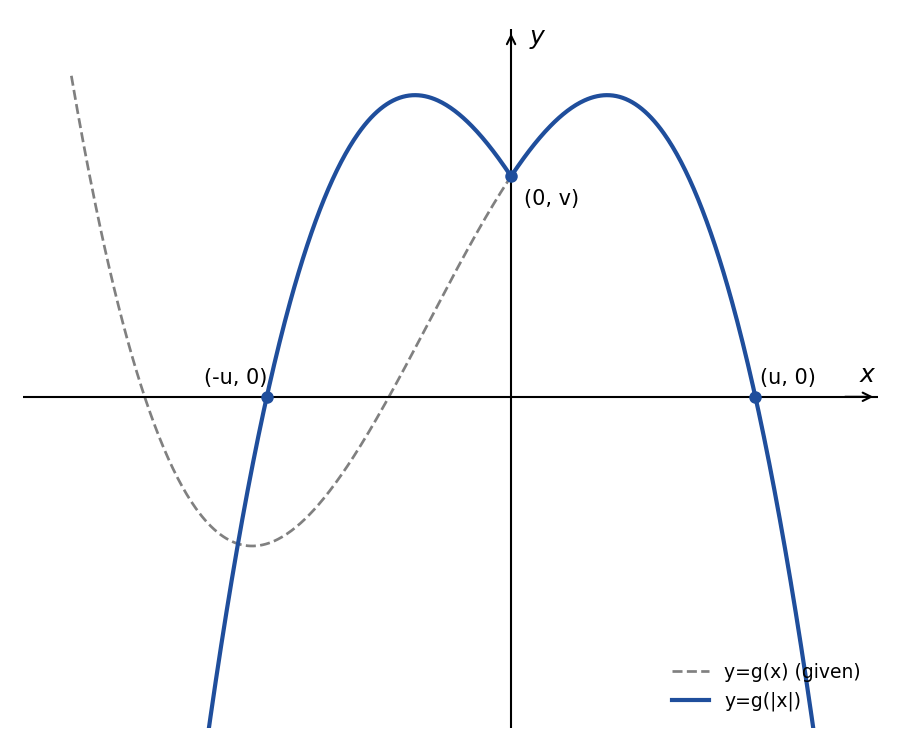
is the even function agreeing with for and mirrored for , cutting the axes at , and .
Part (c)(i) and (ii)
3 marksApproach
to sketch a parametric curve we eliminate to find its Cartesian shape, then use the endpoints of the given range of and the axis-crossings to fix where the sketch starts, stops, and meets the axes.
Since ,
Substituting into ,
This is a sideways parabola, opening in the positive -direction, with vertex at (at ).
Endpoints: gives ; gives .
-axis: , giving — this is also the vertex, since is the only value of with .
-axis: , which lies in , giving , so .
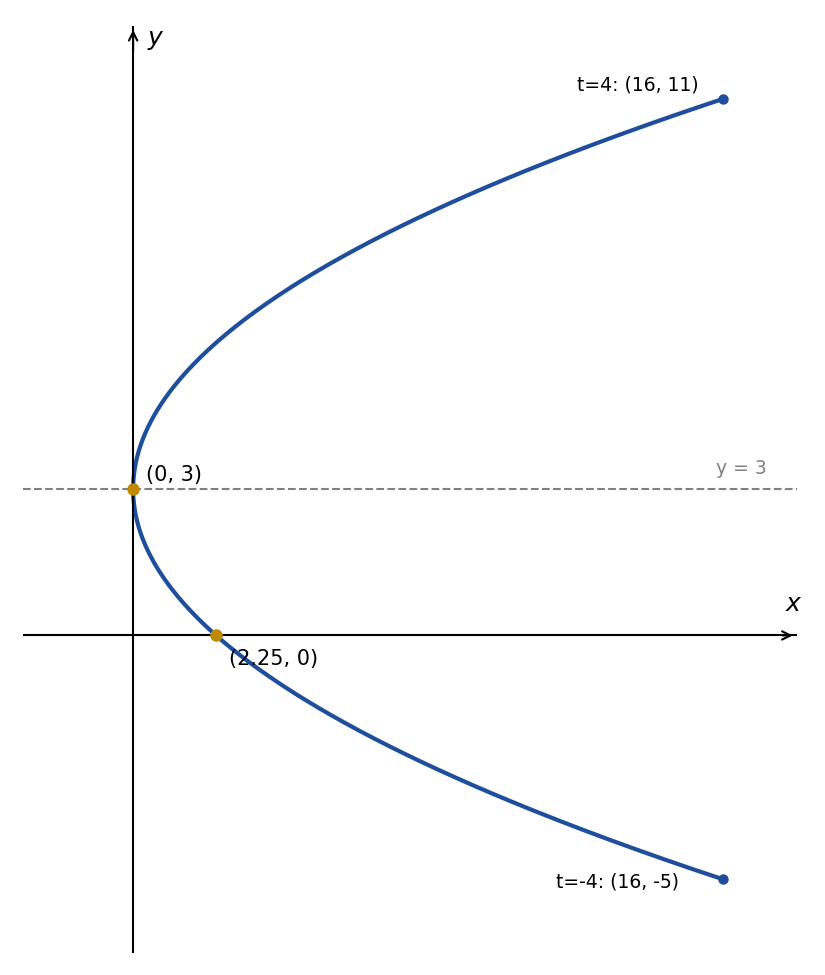
runs from through and the vertex to .
Part (c)(iii)
1 markThe curve is symmetric about the horizontal line through its vertex .
the line of symmetry is .