· H2 Mathematics — Ten-Year Series, worked ← All 11 questions

2019 A-Level · Paper 2 · Question 2

2019 H2 Maths Paper 2, Question 2

Graphs 6 marks rational functions · asymptotes
Download Paper 2 solutions (PDF)

Part (i)

4 marks

Approach

Factorising the denominator locates the vertical asymptotes directly; the degree of the numerator being lower than that of the denominator gives the horizontal asymptote. To fix the shape of the curve between the asymptotes we also find its turning points by differentiating.

Factorising the denominator,

3x2+5x−8=(3x+8)(x−1)3x^{2} + 5x - 8 = (3x + 8)(x - 1)

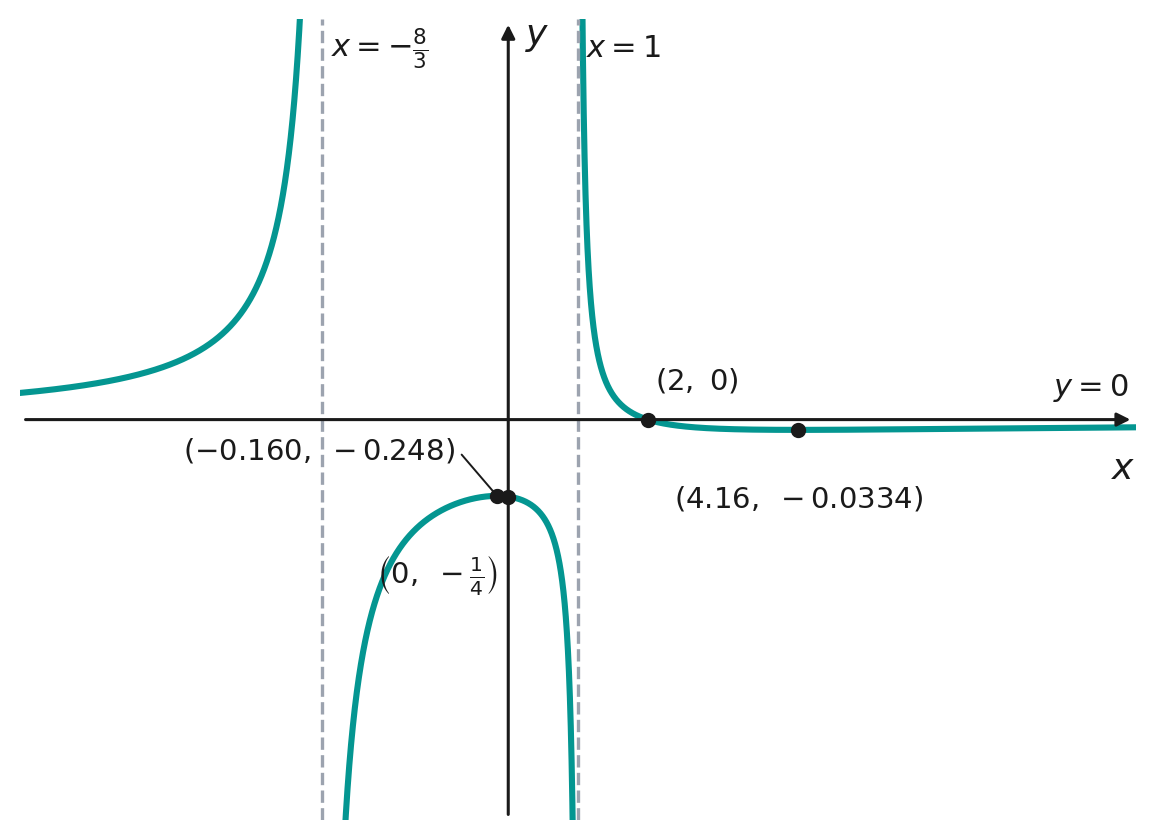
so y=2−x(3x+8)(x−1)y = \frac{2 - x}{(3x + 8)(x - 1)} is undefined at x=−83x = - \frac{8}{3} and at x=1x = 1, giving the vertical asymptotes

x=−83,x=1x = - \frac{8}{3},\quad\quad x = 1

Since deg⁡(numerator)=1<2=deg⁡(denominator)\deg\left( \text{numerator} \right) = 1 < 2 = \deg\left( \text{denominator} \right), y→0y \rightarrow 0 as x→±∞x \rightarrow \pm \infty, so

y=0y = 0

is a horizontal asymptote.

Axis crossings: when x=0x = 0, y=2−8=−14y = \frac{2}{- 8} = - \frac{1}{4}, giving (0, −14)\left( 0,\ - \frac{1}{4} \right); when y=0y = 0, 2−x=02 - x = 0, giving x=2x = 2, so (2, 0)(2,\ 0).

To know which way each branch turns, we differentiate by the quotient rule:

dydx=−(3x2+5x−8)−(2−x)(6x+5)(3x2+5x−8)2\frac{dy}{dx} = \frac{- \left( 3x^{2} + 5x - 8 \right) - (2 - x)(6x + 5)}{\left( 3x^{2} + 5x - 8 \right)^{2}}

Setting the numerator to 00 and solving (by GC), the turning points are at x=2±423x = 2 \pm \frac{\sqrt{42}}{3}, i.e. at

(−0.160, −0.248) (a maximum),(4.16, −0.0334) (a minimum)( - 0.160,\ - 0.248)\ \text{(a maximum)},\quad\quad(4.16,\ - 0.0334)\ \text{(a minimum)}

both to 3 s.f. This gives three branches: one to the left of x=−83x = - \frac{8}{3} rising from near y=0y = 0 to +∞\text{+}\infty; one between the asymptotes, from −∞- \infty up to the maximum (−0.160,−0.248)( - 0.160, - 0.248) and back down to −∞- \infty; and one to the right of x=1x = 1, falling from +∞\text{+}\infty through (2,0)(2,0) to the minimum (4.16,−0.0334)(4.16, - 0.0334) and rising back towards y=0y = 0.

Sketch for question 2

Part (ii)

1 mark
x<−83or1<x<2x < - \frac{8}{3}\quad\text{or}\quad 1 < x < 2

Explanation: reading off the sketch in (i), the curve lies above the xx-axis exactly on the branch x<−83x < - \frac{8}{3}, and on the right-hand branch between the asymptote x=1x = 1 and the intercept x=2x = 2; everywhere else the curve lies on or below the xx-axis.

Part (iii)

1 mark

Approach

the new expression is just the negative of the one in (ii), so its sign is reversed everywhere; we do not need to redo the sign analysis.

x−23x2+5x−8=−2−x3x2+5x−8\frac{x - 2}{3x^{2} + 5x - 8} = - \frac{2 - x}{3x^{2} + 5x - 8}

so x−23x2+5x−8>0\frac{x - 2}{3x^{2} + 5x - 8} > 0 exactly where 2−x3x2+5x−8<0\frac{2 - x}{3x^{2} + 5x - 8} < 0, i.e. on the complement of the set found in (ii) (excluding the asymptotes and the intercept x=2x = 2, where the expression is 00 or undefined).

To check your answer: at x=3x = 3, x−23x2+5x−8=134>0\frac{x - 2}{3x^{2} + 5x - 8} = \frac{1}{34} > 0, and 3>23 > 2 is indeed in the solution set below. ✓

∴−83<x<1\therefore - \frac{8}{3} < x < 1 or x>2x > 2.

This is how we mark, and how we teach.

Every Ten-Year Series question, worked in full, with the reasoning written out and the traps named.

Find out more