· H2 Mathematics — Ten-Year Series, worked ← All 12 questions

2015 A-Level · Paper 2 · Question 10

2015 H2 Maths Paper 2, Question 10

Correlation and regression 9 marks transformed models
Download Paper 2 solutions (PDF)

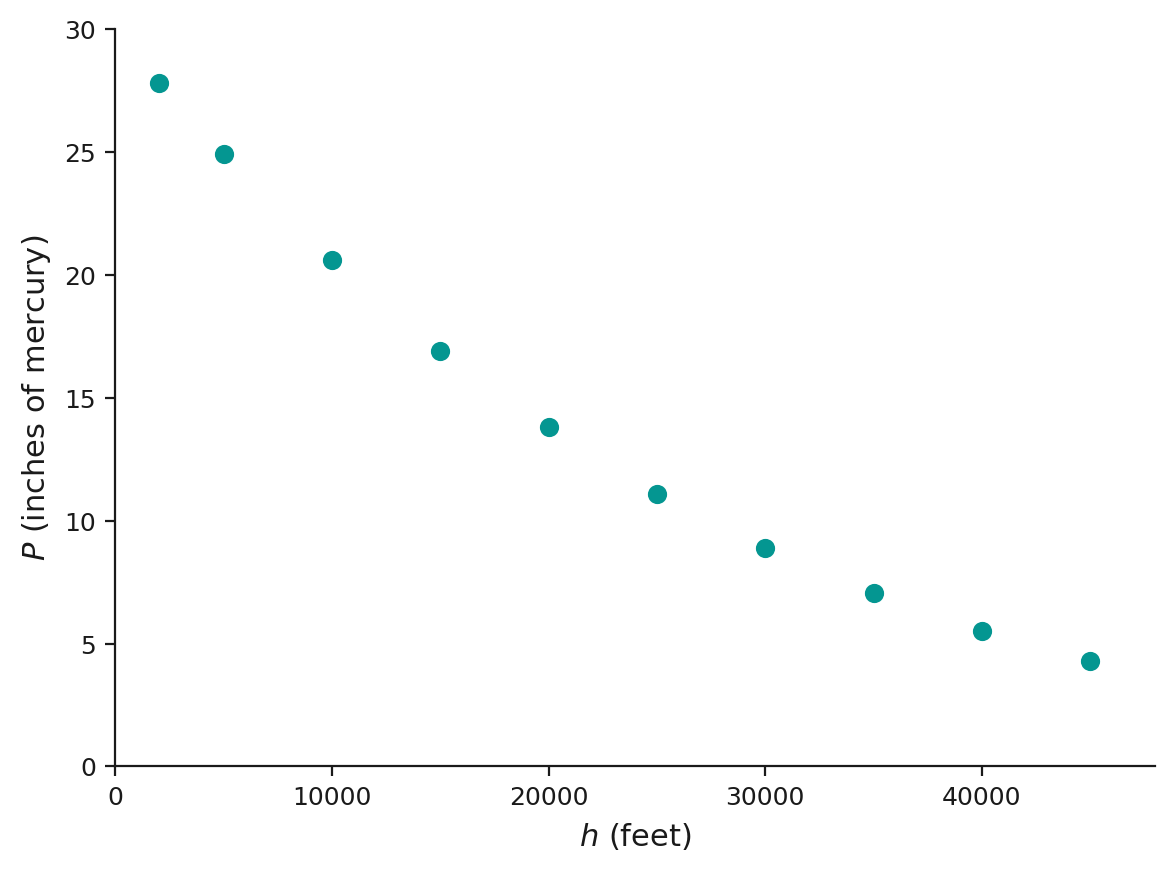
Part (i)

1 mark
Sketch for question 10

Part (ii)

3 marks

By GC, entering the ten pairs of values and computing the product moment correlation coefficient for each transformation of hh:

Part (a)

r=−0.9807r = - 0.9807

Part (b)

r=−0.9748r = - 0.9748

Part (c)

3 marks

r=−0.9986r = - 0.9986

Part (iii)

2 marks

Approach

the “most appropriate” model is the one whose PMCC is closest to −1- 1, since a value of rr nearer ±1\text{±}1 indicates a stronger linear relationship between the transformed variable and PP — and only a variable that is (nearly) linearly related to PP should be used for linear regression.

Since ∣−0.9986∣| - 0.9986| is closest to 11 among the three values in part (ii), the model using h\sqrt{h} and PP is the most appropriate.

By GC, the regression line of PP on h\sqrt{h} is

P=34.789−0.146865hP = 34.789 - 0.146865\sqrt{h}

∴\therefore the equation which best models air pressure at different heights is P=34.8−0.147h (3 s.f.)P = 34.8 - 0.147\sqrt{h}\ \text{(3 s.f.)}, where hh is in feet and PP is in inches of mercury.

Part (iv)

Approach

the equation in part (iii) takes hh in feet. Since 11 metre =3.28\text{=}3.28 feet, a height of hmh_{m} metres corresponds to h=3.28hmh = 3.28h_{m} feet, and we substitute this into the equation from part (iii).

Let hmh_{m} be the height in metres, so h=3.28hmh = 3.28h_{m}.

P=34.789−0.1468653.28hmP = 34.789 - 0.146865\sqrt{3.28h_{m}}
=34.789−0.1468653.28hm= 34.789 - 0.146865\sqrt{3.28}\sqrt{h_{m}}
=34.789−0.265984hm= 34.789 - 0.265984\sqrt{h_{m}}

∴\therefore P=34.8−0.266hm (3 s.f.)P = 34.8 - 0.266\sqrt{h_{m}}\ \text{(3 s.f.)}, where hmh_{m} is the height in metres.

This is how we mark, and how we teach.

Every Ten-Year Series question, worked in full, with the reasoning written out and the traps named.

Find out more